
How to Improve HCAHPS Scores: Why Best Practices Fail - and the Five Foundations That Make Them Work
Hospitals rarely lack HCAHPS best practices. They struggle because those practices are launched without the leadership, data, measurement, and coaching infrastructure required to sustain them. Here are the five foundations that make improvement work.

A state where hospitals compete for patients, physicians, employees, reputation, and market share decided to do something unusual: bring leaders from across its healthcare system together to help one another improve.
That happened in Maryland because the state's hospitals faced a stubborn problem. Despite substantial financial incentives tied to patient experience, Maryland's HCAHPS performance generally lagged other states. Hospitals were already using many of the same widely recommended tactics - hourly rounding, bedside shift report, leader rounding, communication training, discharge practices, and patient-experience dashboards - yet the results were inconsistent.
The problem was not a shortage of best practices.
The problem was that best practices were too often being asked to succeed in environments that could not reliably support them.
I had the privilege of co-chairing the Maryland Patient Experience Learning Collaborative, a partnership between the Maryland Health Services Cost Review Commission and the Maryland Hospital Association. Alongside my co-chair, Dr. Giora Netzer, we worked with patient-experience leaders from hospitals and health systems across Maryland, state regulators, national experts, and survey organizations.
We reviewed statewide data. We surveyed patient-experience professionals. We listened to hospital leaders describe what was working, what was not, and why. We examined examples from organizations that were making measurable progress.
The conclusion should give hope to any hospital executive who feels trapped by stubborn patient-experience results:
HCAHPS scores can improve. But sustainable improvement requires more than selecting the right tactic. It requires creating the conditions that allow the tactic to become consistent practice.
That distinction matters. If your hospital has cycled through patient-experience initiatives without sustained gains, the answer may not be another campaign, another slogan, or another list of best practices. The answer may be to strengthen the operating system underneath the work.
Why Improving HCAHPS Scores Matters
The Hospital Consumer Assessment of Healthcare Providers and Systems, better known as HCAHPS, is the national, standardized, publicly reported survey of patients' perspectives of hospital care. The current instrument contains 32 items and captures aspects of the inpatient experience including communication with nurses and physicians, staff responsiveness, care coordination, medication communication, discharge information, cleanliness, restfulness, overall hospital rating, and willingness to recommend the hospital. The survey is administered to a random sample of adult patients between two and 42 days after discharge. CMS describes HCAHPS as a tool that allows valid comparisons across hospitals.
HCAHPS is not the whole of patient experience. No survey could capture every moment of fear, trust, confusion, dignity, compassion, or coordination that shapes a patient's stay. But HCAHPS is a consequential window into those experiences.
The results are publicly visible. They influence hospital reputation. They affect consumer perceptions. They can reveal breakdowns in communication, responsiveness, teamwork, and reliability. Since 2012, HCAHPS performance has also played a role in hospital payment through the federal Hospital Value-Based Purchasing Program. CMS explains that the program adjusts payments based on the quality of care hospitals deliver and is intended, in part, to improve patients' hospital experiences.
In Maryland, the financial stakes are especially pronounced. The state's Quality-Based Reimbursement program has placed substantial weight on HCAHPS performance. Yet our collaborative found that a strong incentive alone did not guarantee improvement.
That should not surprise us. Incentives clarify what matters. They do not automatically create the capability to deliver it.
HCAHPS Is More Than a Satisfaction Metric
One of the most important conclusions from our work was that HCAHPS should be treated as a quality and safety indicator, not dismissed as a customer-service score.
Patients usually cannot independently evaluate the technical quality of a clinical intervention. They can, however, tell whether team members appear to communicate with one another. They know whether someone responds when they ask for help. They notice whether explanations conflict, whether the environment feels clean, whether their concerns are taken seriously, and whether discharge instructions make sense.
Those signals shape a patient's sense of safety.
During the collaborative, we heard evidence linking stronger patient perceptions of teamwork and safe care with fewer adverse safety events. That relationship is not an argument that HCAHPS alone measures clinical quality or that correlation proves causation. It is a reminder that the conditions patients observe - coordination, responsiveness, professionalism, reliability, and trust - are not separate from the conditions required for safe care.
Frederick Health offered a particularly useful framing: treat patient dissatisfaction as harm.
Under Chief Nursing Officer Jamie White's leadership, the organization applied Lean and process-improvement methods to service failures. Rather than treating dissatisfaction as a vague public-relations concern, the team worked to define, measure, analyze, improve, and control the processes that produced it. Through pilots and Plan-Do-Study-Act cycles, Frederick Health improved HCAHPS results across several areas.
That mindset changes the executive conversation. If an avoidable communication breakdown leaves a patient frightened, confused, or unable to follow the care plan, the organization should not respond with, "That is just a survey issue." It should ask the same questions it would ask after any other failure:
- What happened?
- What conditions allowed it to happen?
- How often is it happening?
- How will we know the corrective action is being performed?
- Who is accountable for learning from the result?
When patient experience is treated as a quality issue, improvement stops being the isolated responsibility of a small patient-experience department. It becomes an operating priority.
The Most Common HCAHPS Improvement Mistake
Most hospitals do not need to be persuaded that communication, rounding, responsiveness, discharge preparation, and empathy matter. Leaders already know these things. Many organizations have invested significant time and money implementing proven practices.
Why, then, do results so often stall?
Because an organization can technically adopt a practice without operationally implementing it.
Consider hourly rounding. A hospital can:
- announce that hourly rounding is a priority;
- educate nurses on a rounding script;
- add rounding to orientation;
- place posters on units;
- ask managers whether rounding is occurring; and
- celebrate the launch at a leadership meeting.
None of those actions proves that patients are consistently experiencing purposeful rounding. None tells leaders whether rounding is happening at the right frequency, whether the interaction addresses what matters to the patient, whether managers can observe and coach it, or whether workflow barriers are making the expected behavior unrealistic.
When scores do not improve quickly, leaders may conclude that hourly rounding "doesn't work here." The organization then shifts to another tactic. Months later, the same pattern repeats.
This creates initiative fatigue. Frontline teams experience patient experience as a series of temporary campaigns. Managers learn that today's priority may be replaced by next quarter's priority. Executives grow skeptical because the organization appears to be doing the right things without seeing the desired result.
The Maryland collaborative's survey captured the problem. Respondents described a mismatch between how highly hospitals said they prioritized patient experience and the resources devoted to improving it. Hospitals relied heavily on HCAHPS outcome data, even though outcome measures do not reveal whether specific practices are being carried out. Many hospitals were trying the same improvement strategies, but the consistency of teaching and coaching those practices was limited.
The implication is straightforward:
Before abandoning a best practice, determine whether the hospital ever built the conditions necessary to implement it reliably.
Five Foundations for Sustainable HCAHPS Improvement
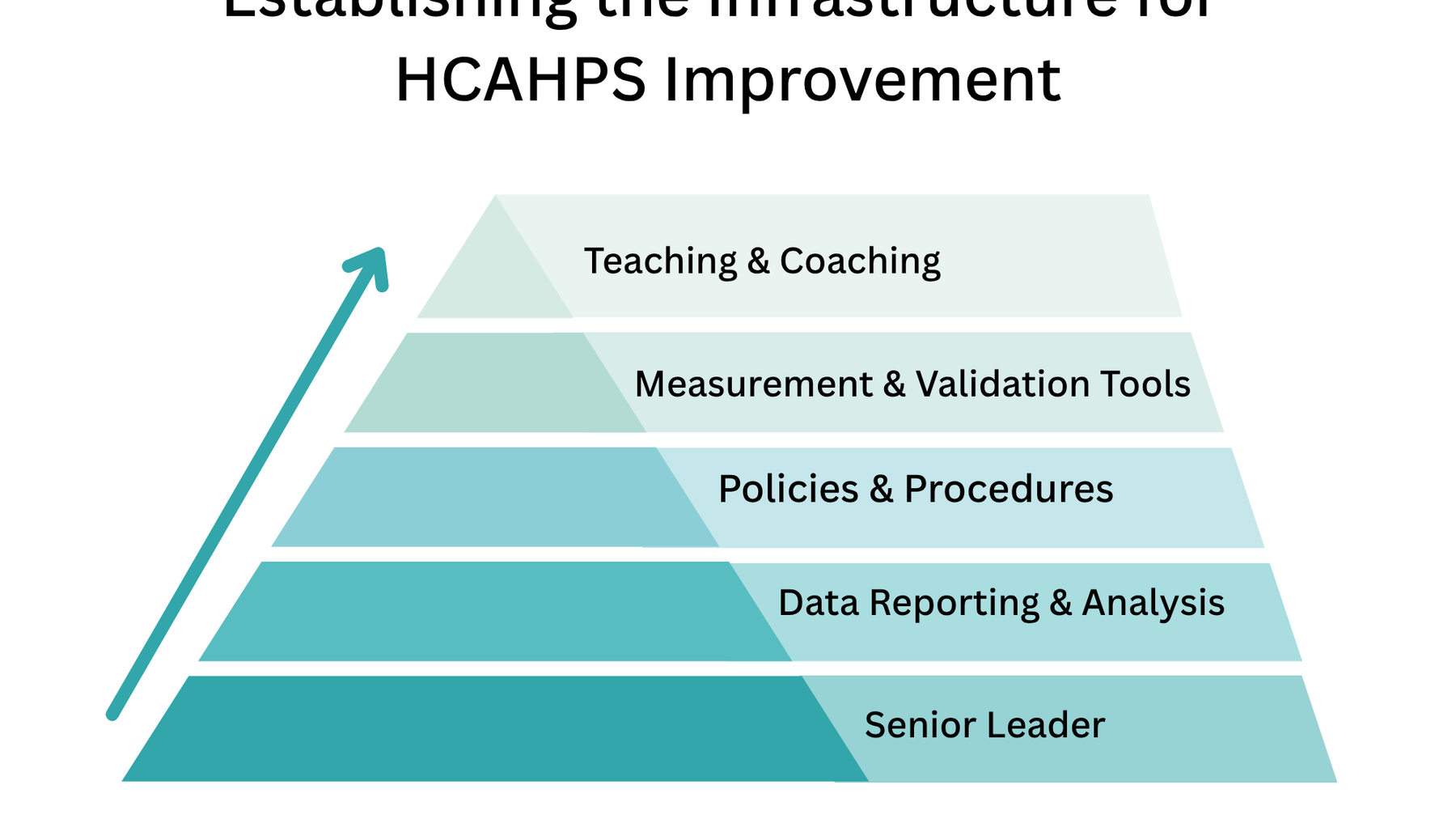
The collaborative identified five foundational elements that support sustained patient-experience improvement. I think of them as a hierarchy because each one strengthens the hospital's ability to implement and sustain what comes next.
These are not five more bedside tactics. They are the infrastructure that makes bedside tactics work.
1. A Senior Patient-Experience Leader With Real Authority
Patient experience needs an executive owner who can translate the patient voice into strategy and coordinate action across clinical operations, quality, human resources, technology, analytics, marketing, and finance.
The title may vary. In some systems, this will be a chief experience officer. In others, it may be a vice president or another senior leader with a broader portfolio. The title matters less than the authority, capability, access, and accountability attached to the role.
The leader needs sufficient proximity to the CEO and executive team to influence decisions that shape care delivery. If patient experience is discussed only after policies, staffing models, workflows, technology purchases, facility decisions, and performance priorities have already been set, the patient voice arrives too late.
This leader should not be reduced to overseeing complaints or presenting survey slides. The role should include:
- establishing an enterprise patient-experience strategy;
- translating HCAHPS and other listening data into operational priorities;
- coordinating improvement across functions and service lines;
- developing leaders' ability to coach patient-centered behaviors;
- identifying barriers that frontline employees cannot remove themselves;
- validating whether practices are being implemented; and
- keeping patient needs present in executive decision-making.
Our survey found that most participating Maryland hospitals did not have a chief experience officer or vice president of patient experience positioned to build this infrastructure. A hospital may still succeed without one particular title, but it cannot succeed without someone doing the work at the appropriate level.
Executive question: Who has both the accountability and organizational authority to integrate patient experience across the hospital?
If the honest answer is "everyone," the practical answer may be "no one."
2. A Clear Data and Listening Strategy
HCAHPS tells you what patients reported after discharge. It does not, by itself, tell you exactly why they answered as they did or which operational change will improve the result.
That makes HCAHPS a vital outcome measure - and an incomplete management system.
Hospitals need a data strategy that connects lagging outcomes with leading process measures and richer listening channels. That might include patient comments, complaints and grievances, real-time rounding data, post-discharge outreach, focus groups, patient and family advisory councils, digital feedback, safety data, employee engagement data, and unit-level operational measures.
The strategy should also create a common language for reporting. Leaders need to know whether they are reviewing adjusted or unadjusted data, which date methodology is being used, what comparison period applies, and whether small sample sizes make a trend unstable. Without standardized definitions, teams can spend more time debating the numbers than improving the experience behind them.
GBMC demonstrated the value of making data usable at multiple levels. Its approach included a monthly internal dashboard, leadership reporting, consultant dashboards, weekly information from its survey database, and concise unit-level snapshots combining key drivers with patient comments. That translation matters. A 70-page enterprise data deck may satisfy an analyst and still fail a nurse manager who needs to understand what to do differently on Tuesday morning.
An effective data strategy should allow an executive to move through three levels:
- Outcome: What are patients reporting?
- Driver: Which experiences, populations, service lines, units, or workflows appear to influence the result?
- Process: Are the behaviors and practices expected to improve that experience actually occurring?
This is where many HCAHPS improvement efforts break down. Hospitals manage the outcome but do not measure the process.
If nurse communication falls, the organization may launch communication training. But did leaders observe the communication? Did they identify which part was breaking down? Did patients understand the plan of care? Did the bedside team use consistent language? Did the unit have staffing or workflow obstacles? Were managers coaching in real time?
You cannot answer those questions from the HCAHPS score alone.
Executive question: Can our leaders connect each priority HCAHPS outcome to a small set of measurable behaviors and operational drivers?
3. Policies and Workflows That Support the Experience You Expect
It is tempting to frame patient experience as a matter of individual attitude: employees should be kinder, communicate better, respond faster, and take greater ownership.
Individual behavior matters. But leaders must also examine whether organizational systems make the desired behavior easy, difficult, or impossible.
For example, a hospital may expect clinicians to include family support people in communication while its policies, technology, physical environment, or routines make inclusion cumbersome. It may ask nurses to provide clear discharge education while forms are duplicative, language is overly technical, responsibilities are fragmented, or the timing is rushed. It may promote responsiveness while call systems, staffing practices, and role ambiguity work against it.
Hospitals should examine the policies and procedures that shape:
- support-person involvement;
- plain-language communication;
- discharge education and documentation;
- interpreter and accessibility services;
- response to complaints and service recovery;
- bedside handoffs and interdisciplinary rounds;
- escalation of unresolved patient concerns; and
- accountability across departmental boundaries.
Luminis Health showed why patient experience cannot be confined to the bedside. By broadening its patient-experience steering structure to include human resources, marketing, performance improvement, quality and safety, operations, and clinical leaders, it treated patient experience as a multidimensional system priority.
That is the correct level of analysis. Patients do not experience your organizational chart. They experience the handoffs between its boxes.
If registration, environmental services, nursing, medicine, food service, transportation, case management, and billing each optimize their own piece without coordinating the whole, the patient experiences the seams.
Executive question: Where do our own policies, handoffs, technologies, and workflow expectations undermine the patient-centered behaviors we say we want?
4. Measurement and Validation of Best Practices
Implementation cannot be inferred from an email, training attendance, a policy update, or a manager's assurance that the team is "doing it."
If a practice matters, the hospital needs a respectful and credible way to validate it.
For hourly rounding, validation might include leader observation, electronic documentation, patient feedback, unit-level audits, or a simple visual management system. For bedside shift report, it might include observation of key behaviors, patient confirmation, and assessment of exceptions. For interdisciplinary bedside rounds, it might include participation, timing, role clarity, and whether the patient understood the plan.
The purpose of validation is not surveillance for its own sake. It is organizational learning.
Validation helps leaders distinguish among several very different problems:
- the practice is not occurring;
- the practice is occurring inconsistently;
- the practice is occurring but not as designed;
- the practice is occurring correctly but does not address the actual driver; or
- the practice is working, but the outcome measure has not yet caught up.
Those situations require different responses. Without process data, they all look like one thing: a disappointing HCAHPS score.
Adventist HealthCare's Shady Grove Medical Center offers a useful example. Hospital leaders invested in teaching nursing leaders how to observe, coach, and document hourly rounding through an electronic platform. The hospital achieved its highest HCAHPS scores in five years. Higher levels of coaching on nursing units correlated with more patient-reported hourly rounding, and units with the greatest rounding improvement had the strongest HCAHPS gains.
The lesson is not simply "do hourly rounding." Hospitals have been told that for years.
The deeper lesson is: define the practice, teach leaders to observe it, measure whether patients experience it, coach the behavior, and learn from variation across units.
Similarly, the University of Maryland Medical System reported positive relationships between patient use of "Get to Know Me" boards and nurse communication results. It also standardized interdisciplinary bedside rounds and found positive correlations with physician and nurse communication scores and patient-perceived rounding frequency.
In both examples, the tactic was connected to evidence about implementation.
Executive question: For each major patient-experience practice, how do we know whether it is happening reliably and producing the intended patient experience?
5. Consistent Teaching and Coaching
Training introduces an expectation. Coaching turns it into behavior.
This may be the most overlooked foundation in HCAHPS improvement.
Healthcare organizations routinely ask technically excellent clinicians to navigate emotionally charged human moments. Patients and families may be frightened, exhausted, grieving, angry, confused, or overwhelmed. Clinicians may be working under intense time pressure while managing competing needs and accumulated stress.
Empathy, expectation-setting, listening, de-escalation, plain-language explanation, and service recovery are learnable skills. They are not always intuitive, and they do not become consistent because someone attended a class once.
Leaders must be able to:
- demonstrate the expected behavior;
- observe it in context;
- give specific and psychologically safe feedback;
- reinforce what went well;
- practice difficult scenarios;
- remove workflow barriers; and
- return often enough for the behavior to become normal.
This is why patient-experience teams need enough capacity to do more than analyze data and respond to complaints. They should be strategic implementation partners who can educate, simulate, observe, coach, and help operational leaders sustain change.
MedStar Health illustrated the importance of building shared leadership understanding through a systemwide Human Experience Summit. LifeBridge Health connected patient-experience strategy with employee identity, engagement, education, and coaching. These approaches recognize that frontline behavior is shaped by leadership behavior.
An executive team cannot demand compassionate reliability while tolerating an internal culture of incivility, ambiguity, or fear. Patients eventually experience the culture employees experience.
Executive question: Are our managers equipped and expected to coach patient-centered behaviors, or are they merely asked to monitor scores?
What I Learned From Improving HCAHPS Performance at RWJ and Adventist
Long before co-chairing the Maryland collaborative, I saw these dynamics firsthand while helping improve patient-experience and HCAHPS performance at Robert Wood Johnson University Hospital and Adventist HealthCare.
The work reinforced a lesson I have carried throughout my career: scores do not move sustainably because leaders find the perfect script. They move when the organization makes the desired experience operational.
That requires visible executive commitment, a coherent strategy, capable leaders, useful data, disciplined follow-through, and repeated coaching. It requires understanding that one nursing unit may face different barriers than another. It requires listening to patients without becoming defensive and listening to employees without lowering the standard.
It also requires patience.
HCAHPS data are delayed. Sample sizes can be uneven. Improvement may first appear in process measures, patient comments, real-time feedback, or a small group of units. Leaders who expect immediate enterprise movement may abandon the work before the system has had time to change.
At the same time, patience cannot become an excuse for vague accountability. The answer is to pair long-term commitment with short-cycle learning. Track the practices now. Listen to patients now. Coach leaders now. Remove barriers now. Use the eventual HCAHPS result as confirmation of a system you are already monitoring.
A Practical 90-Day HCAHPS Improvement Roadmap
Building all five foundations is a long-term effort, but hospital leaders can create momentum within 90 days. The goal should not be to "fix HCAHPS" in one quarter. It should be to establish a disciplined improvement system and prove that the organization can learn.
Days 1-30: Diagnose the System, Not Just the Score
Start with a focused assessment.
- Clarify executive ownership. Identify the senior leader accountable for integrating the work and the executive sponsor able to remove barriers.
- Review performance at the right level. Examine trends by measure, unit, service line, population, and relevant operational context. Avoid chasing normal statistical variation.
- Combine data sources. Compare HCAHPS outcomes with comments, complaints, real-time feedback, safety indicators, employee feedback, and operational measures.
- Map current practices. Identify what the hospital says should happen and what leaders can verify is happening.
- Listen to frontline leaders and patients. Ask where the desired experience breaks down and what makes the expected behavior difficult.
- Choose one meaningful focus. Select a domain, unit, or patient journey with strategic importance, credible opportunity, and engaged local leadership.
The output should be a clear problem statement, not a broad aspiration. "Improve nurse communication" is too vague. "Increase the percentage of patients on two medical units who can explain today's plan of care and identify who to contact with questions" is closer to something a team can manage.
Days 31-60: Design the Practice and the Management System
Once the target is clear, define how improvement will work.
- Specify the behavior. Describe what patients should experience and what staff and leaders will do to create it.
- Identify workflow barriers. Modify policies, responsibilities, documentation, technology, staffing routines, or escalation paths where necessary.
- Select process measures. Choose a small number of leading indicators that show whether the practice is occurring.
- Create a validation method. Decide who will observe, how often, what evidence will be captured, and how feedback will be delivered.
- Prepare leaders to coach. Give managers practice observing the behavior, discussing gaps, reinforcing progress, and responding to resistance.
- Establish a learning cadence. Use frequent short reviews to examine process data, patient feedback, barriers, and adaptations.
Keep the initial design small enough to learn quickly. A well-supported pilot on two units can teach more than an under-supported systemwide launch.
Days 61-90: Test, Coach, and Adapt
The third month is where implementation becomes real.
- Launch with direct leader presence. Executives and operational leaders should be visible, curious, and responsive to obstacles.
- Coach in the work. Do not wait for a monthly scorecard to correct inconsistent behavior.
- Review leading indicators weekly. Determine whether the practice is occurring and whether patients perceive the intended difference.
- Study variation. Compare shifts, days, units, roles, and patient populations. Learn from stronger performance rather than merely ranking teams.
- Adapt without diluting the standard. Change workflow or tools when evidence supports it, while preserving the core patient-centered outcome.
- Decide deliberately. At day 90, determine whether to adopt, adapt, expand, or stop the intervention based on process and experience evidence.
This approach replaces the cycle of launch-and-hope with a cycle of test-and-learn.
Seven Questions for the Executive Team
If your organization is struggling to improve HCAHPS scores, bring these questions to the next executive or board-quality discussion:
- Who is the senior leader with clear authority and accountability for patient-experience strategy?
- Which HCAHPS outcomes are strategic priorities, and what patient or operational evidence led us to choose them?
- What leading process measures tell us whether our improvement practices are actually occurring?
- Which policies, workflows, technologies, or cross-functional handoffs interfere with the experience we expect?
- How do we validate best practices without relying only on self-reporting?
- Are managers trained, supported, and held accountable for coaching patient-centered behaviors?
- What have we learned from units or hospitals that perform better with similar patients and constraints?
If the team cannot answer these questions, do not rush to add another tactic. Strengthen the foundation first.
The Role of Collaboration in HCAHPS Improvement
One of the most encouraging lessons from Maryland was that hospitals can compete and collaborate at the same time.
The collaborative created a setting where leaders could share challenges, visit other hospitals, compare implementations, and learn from different approaches. That accelerates improvement because no hospital has to test every idea sequentially on its own.
The examples were diverse:
- Frederick Health applied process-improvement discipline to service failures.
- Adventist HealthCare strengthened hourly rounding through observation, coaching, and measurement.
- LifeBridge Health connected patient experience with strategy and employee engagement.
- UMMS standardized patient-centered communication tools and interdisciplinary bedside rounds.
- GBMC translated complex data into usable unit-level insight.
- Johns Hopkins used communication and operational changes to improve the experience of long emergency-department waits.
- Luminis Health broadened patient-experience governance across functions.
- MedStar Health invested in shared leadership education and alignment.
The power was not in declaring one organization the winner. It was in examining which practices worked, under what conditions, for which patients, and how leaders knew.
That is the kind of conversation health systems need internally as well. Units should not be treated merely as red, yellow, or green boxes on a dashboard. They should be treated as laboratories for learning. A high-performing unit has knowledge to share. A struggling unit has barriers to understand. Both deserve curiosity.
Can HCAHPS Scores Really Improve?
Yes. The Maryland experience gives hospital leaders reason for optimism.
But optimism should be paired with realism. HCAHPS improvement is rarely the result of one dramatic intervention. It comes from making care more consistently responsive, coordinated, understandable, respectful, and reliable - then building a management system that sustains those conditions.
That is why copying another hospital's tactic is not enough. Your hospital has its own patients, workforce, culture, service lines, technology, physical environment, operating pressures, and history. The best practice may be transferable, but the implementation plan cannot simply be photocopied.
The right question is not, "Which HCAHPS best practice should we try next?"
The better questions are:
- What are our patients telling us?
- What process is producing that experience?
- What behavior or workflow must change?
- What foundation is missing?
- How will we know the change is happening?
- How will leaders coach and sustain it?
Hospitals can move HCAHPS scores. I have seen it in my own work, and our statewide collaborative documented examples across Maryland. The path forward is not mysterious, but it does require discipline.
Best practices matter. The environment that makes them work matters more.
Frequently Asked Questions About Improving HCAHPS Scores
What is the fastest way to improve HCAHPS scores?
There is no universal shortcut, and leaders should be cautious of anyone promising one. The fastest responsible path is to identify a specific patient-experience problem, connect it to a measurable operational process, test an evidence-informed practice in a focused setting, and coach and validate the behavior frequently. Broad systemwide campaigns often move more slowly because they dilute support and make learning difficult.
Why do HCAHPS best practices fail?
Best practices often fail because they are announced but not fully implemented. Common causes include unclear ownership, insufficient executive support, weak process measurement, inconsistent workflows, limited validation, inadequate manager coaching, initiative fatigue, and failure to adapt the practice to the hospital's patient population and operating environment.
Which HCAHPS improvement strategies work?
Research and hospital experience support strategies such as purposeful rounding, bedside shift report, interdisciplinary bedside rounds, effective discharge communication, post-discharge follow-up, leader rounding, communication coaching, and real-time service recovery. However, the presence of a strategy is not the same as reliable implementation. Hospitals should choose strategies based on their own data and validate whether the intended behavior and patient experience are occurring.
How long does it take to improve HCAHPS scores?
The timeline varies based on baseline performance, sample size, survey lag, the measure being targeted, and the scope of change. Hospitals may see movement in leading process measures and real-time feedback before HCAHPS results change. Leaders should monitor both short-cycle implementation data and longer-term HCAHPS trends rather than expecting one month's score to prove success or failure.
Who should own HCAHPS improvement?
A senior leader should have clear accountability for patient-experience strategy, but the work must be shared across operations, nursing, medicine, quality and safety, human resources, analytics, technology, environmental services, and other functions. Patient-experience professionals should serve as strategic partners and implementation experts, not as the sole owners of every interaction that affects the patient.
Is HCAHPS the same as patient satisfaction?
Not exactly. HCAHPS is a standardized survey of specific patient perspectives and experiences during a hospital stay. Patient experience is broader than any single survey and includes the full range of interactions, processes, environments, expectations, and relationships that shape care. A strong improvement strategy uses HCAHPS alongside other listening and operational data.
How can a hospital improve HCAHPS without overwhelming staff?
Focus is essential. Select a limited number of priorities, involve frontline employees in diagnosing barriers, integrate the desired behaviors into existing workflows, give managers practical coaching tools, and remove low-value work that competes with the new expectation. Staff are more likely to support improvement when leaders listen to their experience and design changes that make excellent care easier to deliver.
A Final Word for Hospital Leaders
If your hospital's HCAHPS scores have remained stubborn despite repeated improvement efforts, I understand the pressure and frustration that can create. It can feel as if the organization has tried everything.
Usually, it has tried many things. That is not the same as building a system capable of sustaining them.
The hopeful lesson from Maryland is that improvement is possible. Hospitals do not have to accept stagnant patient-experience results as permanent. They can create clearer accountability, better listening systems, supportive policies, credible process measures, and stronger coaching cultures. When those foundations are in place, familiar best practices can finally produce the results leaders expected from them.
At Apex Leadership Institute, I help hospitals and health systems diagnose the conditions beneath their HCAHPS performance and translate patient-experience goals into practical leadership and operating systems. My approach is grounded in the improvement work I led at Robert Wood Johnson University Hospital and Adventist HealthCare, as well as the lessons I learned co-chairing Maryland's statewide Patient Experience Learning Collaborative.
If this article helped you see your HCAHPS challenge differently, start with the seven executive questions above. They will tell you whether your organization needs another tactic - or a stronger foundation.
And if an outside perspective would be useful, contact Apex Leadership Institute to begin a conversation about your patient-experience strategy.
Jonathan Sachs is the founder of Apex Leadership Institute. His experience spans senior health care administration, patient experience transformation, government leadership, executive coaching, and university education — a rare combination that positions Apex uniquely at the intersection of leadership development, health care operations, and frontline patient care.
Connect on LinkedInRelated Insights
All insights →TEDx Talk on Patient Experience
How can healthcare leaders improve patient experience? In his TEDx Talk, former Chief Experience Officer Jonathan Sachs explores how communication, clarity, and empathy can make healthcare better for patients and families.

Healthcare Administration Networking Strategies That Actually Work
A practical guide to healthcare administration networking, including the best associations, executive outreach messages, conference follow-up, relationship-building, and a focused 30-day plan.

MHA Fellowship vs. Coaching: Which Path Is Right for You?
Compare an MHA administrative fellowship with healthcare-specific career coaching, including structure, cost, employer value, ideal candidates, and a practical 90-day action plan.